There's a moment every Indian wedding season when a couple sits down to choose their invitation and runs into the same wall — hundreds of templates, all with their names and dates dropped in, and not a single one that feels like it actually belongs to them.
We've spent two years thinking about why that happens — and what to do about it.
What “authentic” actually means
In wedding-invitation design, the word authentic gets thrown around constantly. Most of the time it means “uses some traditional motif somewhere on the page” — a paisley, a kalash, a peacock, an Eiffel Tower if the wedding is in Paris. But a paisley alone does not make a card Marwari, any more than a single mantra makes a wedding Hindu.
What makes a card actually feel like it belongs to a tradition is something deeper: the ritual order, the family hierarchy, and the visual grammar of that specific community.
“A paisley alone does not make a card Marwari, any more than a single mantra makes a wedding Hindu.”
Three tests every culturally authentic invitation must pass
1 · The motif test
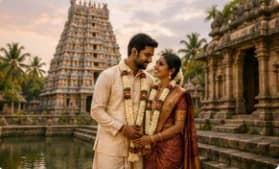
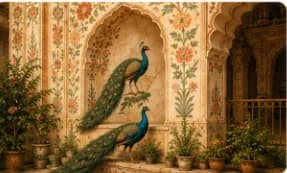
Look at the visual elements. Are they specific to your tradition, or generic? A Tamil Brahmin Kalyanam invitation should not feature a stock peacock and call it done — it should reference Meenakshi-style temple architecture, the kalyana mandapam, the golden lamps that frame the muhurtham. A Marwari card should show phad-style composition, mirror-work edges, and the specific palette of Bikaner reds and Jaipur blues.
2 · The ritual order test
Read the schedule. Does it list events in the order your community actually does them? A Punjabi card that opens with “wedding” and then mentions “anand karaj” two lines later as a separate event has missed the point. So has a Tamil card that calls the muhurtham a generic “ceremony” instead of giving it the centerpiece position it deserves.
3 · The elder test
Show it to your grandmother. If she squints, frowns, or asks “who designed this?” with a tone of suspicion — it has failed. The elder test is the only one that ultimately matters. Elders carry the cultural memory of what these things should look like, and a digital invitation that passes the elder test passes everything.
How to tell when a digital template gets it right
A culturally precise digital template will:
- Name the ritual sequence in your community's own terms (Muhurtham, not “ceremony”; Anand Karaj, not “wedding”; Saat Phere, not “vows”)
- Include space for grandparents and great-grandparents on both sides — not just the bride and groom
- Use fonts, colours, and motif language drawn from your specific tradition, not a generic “wedding aesthetic”
- Have been reviewed by someone who grew up inside that tradition before it ever launched
When all four of these are true, you have found something worth sending.
Why we built OneTouchInvite this way
We are a small studio split between Bangalore and Madurai. Every template we have launched has been co-designed with an artist from inside that tradition — a Marwari artist for the Marwari card, a Madurai-born designer for the Meenakshi card, a Nair-family designer for the Kerala one.
We could have built faster. We could have launched twelve templates in three months by hiring a generalist illustrator and feeding them Pinterest mood-boards. Plenty of competitors do exactly that.
We didn't, because the elder test matters more than the speed.
The next template we add could be yours.
If your tradition is already in our collection, we hope you'll try it and run all three tests on the result. If it isn't yet — write to us and tell us what to look for.